
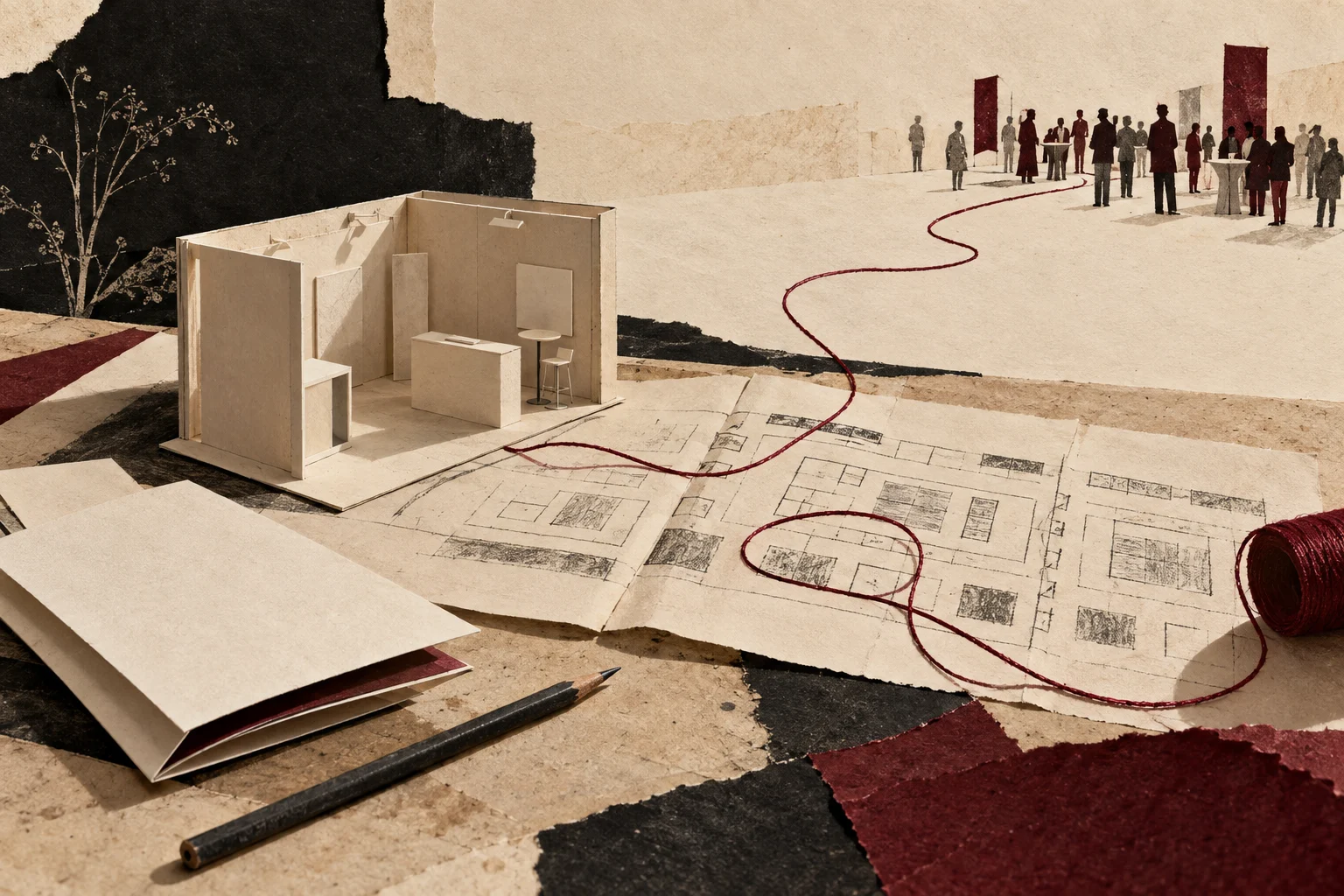
The booth is a threshold. What matters is what people can imagine on the other side.
A conference gathers people inside a temporary world. The usual routines loosen. The room is full of ideas in motion, and for a few days, change can feel unusually close.
That feeling matters. It gives people permission to pay attention to something new and picture themselves participating in it.
But a person can feel inspired at a conference and return home unchanged. The event has to make more than a strong impression. It has to help someone connect the idea to a decision they can actually make.
Design for recognition.
A booth is a small environment inside a much larger one. Before anyone reads the copy, it signals what kind of place this is and whether they belong in the conversation.
The strongest invitation is not simply “come see what we do.” It gives the right person a reason to recognize their own situation: a problem they have struggled to name, a possibility they want to test, or a question they have not been able to answer.
That recognition can shift someone from passing by to leaning in. They begin to see the business as relevant to their world.
Research on conference attendees found that interaction with other attendees—particularly social and emotional support—was associated with stronger identification with the group and a more meaningful conference experience. The point is not to manufacture a crowd around the booth. It is to give people a reason to recognize a shared concern and engage with one another around it. Wei et al., “Customer-customer interactions at conferences”.
A crowd is easy to assemble. A sense of belonging takes something in common.
Give the idea room to travel.
A stage gives an idea public weight. The speaker is asking a room to consider a claim together.
That attention can make the idea feel consequential. It can also disappear with the applause. The test comes later: can someone explain the idea to a colleague? Can they connect it to a decision they face? Do they know what would help them act?
The breakout changes the attendee’s role. They are no longer only listening; they are trying the idea against their own work. That participation can make the idea feel more possible because people have begun to see where they fit.
The experience should leave them with a useful shift in understanding. If it only leaves them with excitement, the business has more work to do.
Do not mistake excitement for action.
“Dopamine” often gets used as shorthand for a pleasurable rush. The science is more specific: dopamine systems help the brain learn from reward and update its expectations. That does not mean a display or a clever interaction can reliably trigger a “dopamine hit” that makes someone buy. Schultz, Dayan, and Montague, “A neural substrate of prediction and reward.”
For a business, the useful question is simpler: what makes the experience worth continuing after the initial novelty wears off?
The attendee drives home. Their inbox is waiting. The team returns to the work it left behind. Whatever felt possible in the conference room now has to compete with schedules, budgets, internal questions, and the effort of changing how things are done.
That transition is where interest can thin out.
The follow-up has to restore the context of the conversation. What was the person trying to solve? What did they want to understand? What would help them explain the opportunity to someone who was not in the room?
A generic note cannot do that. It asks the recipient to reconstruct the value on their own. A considered follow-up brings the relevant part of the conversation back and makes the next step clear.
The ride home matters because the attendee is already turning the event into a memory. Research on remembered experiences suggests that emotionally salient moments and the ending can influence how an experience is evaluated later. That does not guarantee conversion; it does make the last interaction worth designing. “From Experience to Memory: On the Robustness of the Peak-and-End-Rule for Complex, Heterogeneous Experiences.”
Do not let the experience end at the booth. Give the conversation a useful conclusion and a way to continue.
The booth is only one part of the decision.
The conference begins before someone enters the hall. They may have seen the invitation, heard about the company, or arrived with an expectation of what it does. The booth either confirms that understanding or makes the visitor work harder to place the business.
The same is true on stage. A compelling claim creates an expectation. The experience afterward has to give people a way to examine it for themselves.
This is the deeper assignment: help people understand what the business makes possible, recognize why it matters to them, and carry that understanding into the next decision.
RUINE begins with the business’s intended move and the people whose decisions matter to it. We define what the situation calls for, curate what is needed, and direct the work around one point of view. Sometimes that work includes a booth. The more important work is making sure the experience has somewhere to lead.
Before you build the booth, decide what you want people to feel part of—and how you will help them act once they are back in their own world.